Tuesday e
 vening became interesting in right about the middle of it. I had just come back from a weekly client meeting around 9 and sat down at the computer to clear my mail do my normal boring day end business. In the background I rotate the TV between the BBC, CNN, Bloomberg and CNBC - the only English channels available on my German TV. And
  in the background a commercial shows up, I don't know exactly for what, and they talk about a long list of speakers coming to Munich for a 'creative conference'. Hold on. Creative conference? That's my business! But the Internet takes over again and I'm back to my work without being able to understand what the commercial was actually for. I work with my back to the TV for a reason - nothing much worth watching, usually. I still have a cassette tape, and not a videotape of the film, "My Dinner With Andre", because the dialogue IS the entire film. It's just two guys sitting at a table talking. News TV is mostly the same. Talking heads.
But the commercial comes on again, I am cued by the sound, and I swing around sit and watch. At the end it says, www.DLD-Conference.com . What the heck is DLD? Never heard of it. Been in Asia too long. Sounds interesting. So I immediately go to the web. And pull up a site. Jeeziz. Because Jesus is the only person not speaking apparently - and the speaking list is not only impressive, it's extensive. Nearly 150 actuaries in Science, The Arts, Technology, Venture Capitol, a Nobel Laureate and even a Princess. Curioser and curioser. The DLD site describes the conference as such:
"DLD (Digital. Life. Design) is a three-day experience gathering 800 entrepreneurs, investors, philantropists, scientists, artists and creative minds from all over the world. With global diversity in attendees and an interdisciplinary perspective of digital, media, design, art, science, brands, consumers and society, the conference is known as the European forum for the creative class".
So I immediately go to the registration area of the site. But I am told summarily, like the bouncers at P1 will tell you, that I cannot come in. Registrations are closed. What next? And why are they running a commercial on national TV promoting the event and then not letting anybody in once we do what 'direct response' advertising wants us to do, which is 'respond'? Who knew?. As I am writing this, the commercial continues to run on CNN, one day later. Why might that be?
But whadayawant in advertising? Logic? I have been a Vice President at Leo Burnett in Chicago and was even sent to Asia by Michael Conrad, a very nice German and I can tell you, logic had very little to do with a lot in that business. I was the man available on the day they needed a man available in Asia, and off I went. My CV had little to do with it either. It was simply just good enough to not have killed the deal. Advertising and logic belong together sometimes like the words Army and intelligence.
As it turns out, the social networking site Xing, here in Germany, is a sponsor, and I know a few folks up there. Maybe they can help me do a work around. Letters to Xing. Type, type, type. I am a horrible typist. Next up. Brain freeze.
After that, Technorati. I had registered as a writer for Technorati last summer and been accepted but never written a thing. Why? Because basically, I do better on my own and most of my stories are not big news events. To write for another site, you make no money, do a lot of work, and are subject to editorial killing just like a regular job. So why do it? I can publish what I want, do what I want, and get a small but high level readership all on my own on most days. And as opposed to a lot of bloggers out there, I can do that - and get read no matter what I choose to write about. Why? I don't know exactly why. When there's no money involved, it just works that way. I choose my audience and they choose me.
But this instance was different. Here was a story that not only was I interested in, but one that Technorati would actually be interested in as well, and I had received an email from them just last week that encouraged all of us writers to "do more". Why? Because writers were not submitting content to them like they thought they would. Why? Because nobody wants work for free. I had turned down a speaking engagement last year with the Saigon Digital Marketing Conference for the same reason. The sooner this Web 2.0 animal figures that out, the better. There's a not a world of 'citizen journalists' just sitting around waiting to be published for nothing. No, we all work for a living. That's how we eat.
But Technorati should be interested I thought. I am in Munich, and it just makes good sense. I had just written a series called "wHAT's wRONG wiTH mY sOCIAL nETWORKING?" And this conference seems to have the answer to that question in that it brings creative people and Internet development people together. So off to Technorati I would go. A letter to their Executive Editor and a message back in just a few minutes. His response to my query on their need for a writer and stories on the event? "Go for it!".
And that was all the approval I needed - but sorting through the DLD website here in Munich would not be near as easy as getting the go-ahead from a publication based far away in San Francisco. A visit to DLD's contact page gives you two of those impersonal email addresses - you know the ones that say info@website.here or press@website.there - and then a visit to the 'team page' gives you a flurry of nice B&W photos of people doing certain jobs and another page to click on for what is described as 'detailed contact information'. A click on that and guess where you go? Right back to the first contact page with the same two anonymous email addresses. Hmmm. I eventually went to Xing, DLD's corporate partner in the conference, and was able to send personal notes to people who seemed to be directly involved in the production. No response from that quite yet.
So where I stand right now is in having a publication to represent but still needing approval from the conference and no, no matter what happens, I will not be paid, but I'm sure I can schlurp coffee and bag a few scones for breakfast. The interest here is in the quality of the presenters and the mix of personalities - the chance that real ideas may be proposed and even moved forward in an atmosphere where old media and new media could certainly do a lot more in each other's benefit than they might sometimes believe. Hubert Burda, below, has made that a mission. Scientific thought processes, sociological thought processes, artistic thought processes and business thought processes all strewn together for a few days will surely produce more inspiring writing than I might be able to do at home on my own as I did last year for a few conferences in Vietnam.
And s
 hould I not get a press pass, there's always the option of covering it as Hunter S. Thompson covered the Roxanne Pulitzer divorce trial, Gonzo style. Thompson, finding the courtroom barred from reporters, simply grabbed the transcripts he could from grocery carts full of them wheeled into the courthouse hallway, and retreated to a nearby pub to watch the trial on TV and interview other pub patrons on the goings on of the trial - but with this not being a drug infused, high profile, sex scandal, I can't imagine that option being particularly effective - or nearly as entertaining.
So now you wonder - what's that funny little graphic that leads off this story? That is my own personal DLD Molecule. Or in this case, the personal Molecule of Infinite Wisdom Consulting. The way it works is that you type the letters of either your name, or your company's name into the DLD Moleculator on the site and it runs it through a little algorithm that determines the shape. I like how in our case, there are lots of diametric converging lines, but that the overall direction of the mark produces one straight and clear line, right down the middle, pointing up, mind you. That in many ways, is how creative businesses should go - examining many opportunities and options, but still headed up towards a single goal. Neat. I though this was neat.
Last night I stayed up until a fairly insane hour of the morning reading all, and I did read them all, of the nearly 150 bios of speakers and panelists for the event. Here are just a few that would be memorable for me and Technorati readers: (Click to see full bios on the DLD site)
Aar
 on Koblin is an artist specializing in data visualization. His work takes social and infrastructural data and uses it to depict cultural trends and emergent patterns. Aaron's work has been shown at international festivals including Ars Electronica, SIGGRAPH, OFFF, the Japan Media Arts Festival, and TED. He received the National Science foundation's first place award for science visualization and is part of the permanent collection of the Museum of Modern Art (MoMA) in New York. Currently, Aaron is Technology Lead of Google's Creative Lab where he helped to launch Chrome Experiments, a website showcasing JavaScript work by designers from around the world.
 David Kirkpatrick, longtime senior editor for internet and technology at Fortune Magazine, has written for two decades about the computer and technology industries, as well as the impact of the Internet on business and society. His book, entitled "The Facebook Effect: The Inside Story of the Company that is Connecting the World" will be published by Simon & Schuster in the US June 15, 2010. The book describes Facebook's history and how this newly-dominant Internet force is changing behaviors across societies worldwide. He maintains a blog at facebook.com/thefacebookeffect.
Dr.
 Hubert Burda is Chairman of the Board and Publisher of Hubert Burda Media. He is President of the Association of German Magazine Publishers (VDZ) and co-founder of the European Publishers Council (EPC). He set up the Hubert Burda Foundation with a view to promoting interdisciplinary exchanges on future trends. Hubert Burda also founded the Burda Center for Innovative Communications at the Ben Gurion University in Beer Sheva, Israel.He has been awarded numerous prizes and distinctions for his achievements in publishing and business, including the European Print Media Prize and the Gold Medal Freedom of Speech of the European Association of Communications (EACA).
 Although best known for founding Wikipedia.org, Jimmy Wales has also set up the Wikimedia Foundation in 2003 and co-founded Wikia, Inc., in 2004. Recently, The World Economic Forum recognized Wales as one of the "Young Global Leaders" of 2007. This prestigious award acknowledges the top 250 young leaders across the world for their professional accomplishments, their commitment to society, and their potential to contribute to shaping the future of the world. Wales also received the "Time 100 Award" in 2006, named one of the world's most influential people in the "Scientists & Thinkers" category. Wales received his bachelor's degree in finance from Auburn University and his master's in finance from University of Alabama.
 As the leader of the Mozilla Project, Mitchell Baker organizes and motivates a massive, worldwide collective of employees and volunteers who are breathing new life into the Internet with the Firefox Web browser and other Mozilla products. Baker received her BA in Asian Studies from UC Berkeley and her JD from the Boalt Hall School of Law. Her law career included working for Sun Microsystems and Netscape. Baker has been the general manager of the Mozilla project since 1999, helping shape the license under which Netscape's source code was released. As Chairman of the Mozilla Foundation, Baker continues her commitment to an open, innovative Web and the infinite possibilities it presents.

After serving in the U.S. Marine Corps, and after his studies in Utah, Harvard and Cornell, John Naisbitt worked for IBM and Kodak. In 1963 he went to Washington where he became the Assistant Secretary of Education to President Kennedy, and Special Assistant to President Johnson. Since the global success of Megatrends and the 10 books that followed, he has traveled around the globe several times a year and has spoken to almost all the major corporations of the world. He is the recipient of 15 honorary doctorates in the humanities, technology and science. He and his wife divide their time living in Vienna, Austria and in Tianjin, China, where in 2007 they established the Naisbitt China Institute at Tianjin University.
 Jonathan Harris makes projects that reimagine how humans relate to technology and to each other. Combining elements of computer science, anthropology, visual art and storytelling, his projects range from building the world's largest time capsule (with Yahoo!) to documenting an Alaskan Eskimo whale hunt on the Arctic Ocean. He is the co-creator of We Feel Fine, which continuously measures the emotional temperature of the human world through large-scale blog analysis. After studying computer science at Princeton University, he won a 2005 Fabrica fellowship and three Webby Awards. He has given talks at Google, Princeton and Stanford Universities, the TED Conference, and at two hippy forest gatherings. His projects have been shown at MoMA (New York), Le Centre Pompidou (Paris), and have appeared on CNN, NPR, BBC, and Bhutanese television.
 Reid Hoffman was LinkedIn's founding CEO for the first four years before moving to his role as Chairman and President, Products in February 2007. While CEO, Reid built the company to over 9 million members and profitability; Linkedin now has over 50 million members worldwide. Prior to LinkedIn, Reid was Executive Vice President of PayPal. At PayPal, Reid was in charge of all business relationships: business development, corporate development, international, government relations, and banking/payments infrastructure. During his tenure at PayPal, Hoffman was instrumental to the acquisition by eBay and was responsible for partnerships with Intuit, Visa, MasterCard and Wells Fargo. Reid also has held management roles in large technology companies, including Fujitsu Software Corporation and Apple. Currently, in addition to LinkedIn, Reid serves on the Board of Directors for SixApart and Mozilla Corporation (Firefox).
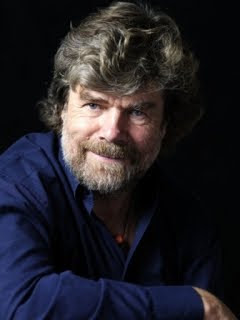 The Italian mountaineer and explorer from South Tyrol, Reinhold Messner, often cited as the greatest mountain climber of all time brought his sport to new heights. He is renowned for making the first solo ascents of Mount Everest without supplemental oxygen and for being the first climber to ascend all fourteen "eight-thousanders" (peaks over 8,000 metres above sea level). Messner has crossed Antarctica on skis and the desert Gobi. Messner is the author of at least 63 books. From 1999 to 2004, he held political office as a Member of the European Parliament for the Italian Green Party. He co-founded Mountain Wilderness, an international NGO dedicated to the protection of mountains worldwide and dedicates himself to the Messner Mountain Museum.
I first heard of Reinhold Messner from a Ben Folds album cover. A few weeks ago someone had referred me to Jonathan Harris' website related to a job that we were doing, and we even traded a few emails this week. What an interesting life I have sometimes. To be able to come face to face in the line of my work with many of the people who shape my work. In many cases, I get to hire them and in some other cases we might become friends. I often tell students and those needing a little mentoring to make their dreams big - not to skimp on the fantasies - but also to make them real. Real enough just just get a little bit of it every few years or so. This breeds hope and hope, eventually breeds success.
My job now is to get through to the conference and speak with those who cover press. Had I heard about this earlier, I might not be in a time crunch now. Or had they advertised this earlier, they might not have had to put up with my silliness at this late date. I'll keep you posted.
 Jonathan Harris makes projects that reimagine how humans relate to technology and to each other. Combining elements of computer science, anthropology, visual art and storytelling, his projects range from building the world's largest time capsule (with Yahoo!) to documenting an Alaskan Eskimo whale hunt on the Arctic Ocean. He is the co-creator of We Feel Fine, which continuously measures the emotional temperature of the human world through large-scale blog analysis. After studying computer science at Princeton University, he won a 2005 Fabrica fellowship and three Webby Awards. He has given talks at Google, Princeton and Stanford Universities, the TED Conference, and at two hippy forest gatherings. His projects have been shown at MoMA (New York), Le Centre Pompidou (Paris), and have appeared on CNN, NPR, BBC, and Bhutanese television.
 Reid Hoffman was LinkedIn's founding CEO for the first four years before moving to his role as Chairman and President, Products in February 2007. While CEO, Reid built the company to over 9 million members and profitability; Linkedin now has over 50 million members worldwide. Prior to LinkedIn, Reid was Executive Vice President of PayPal. At PayPal, Reid was in charge of all business relationships: business development, corporate development, international, government relations, and banking/payments infrastructure. During his tenure at PayPal, Hoffman was instrumental to the acquisition by eBay and was responsible for partnerships with Intuit, Visa, MasterCard and Wells Fargo. Reid also has held management roles in large technology companies, including Fujitsu Software Corporation and Apple. Currently, in addition to LinkedIn, Reid serves on the Board of Directors for SixApart and Mozilla Corporation (Firefox).
 The Italian mountaineer and explorer from South Tyrol, Reinhold Messner, often cited as the greatest mountain climber of all time brought his sport to new heights. He is renowned for making the first solo ascents of Mount Everest without supplemental oxygen and for being the first climber to ascend all fourteen "eight-thousanders" (peaks over 8,000 metres above sea level). Messner has crossed Antarctica on skis and the desert Gobi. Messner is the author of at least 63 books. From 1999 to 2004, he held political office as a Member of the European Parliament for the Italian Green Party. He co-founded Mountain Wilderness, an international NGO dedicated to the protection of mountains worldwide and dedicates himself to the Messner Mountain Museum.
I first heard of Reinhold Messner from a Ben Folds album cover. A few weeks ago someone had referred me to Jonathan Harris' website related to a job that we were doing, and we even traded a few emails this week. What an interesting life I have sometimes. To be able to come face to face in the line of my work with many of the people who shape my work. In many cases, I get to hire them and in some other cases we might become friends. I often tell students and those needing a little mentoring to make their dreams big - not to skimp on the fantasies - but also to make them real. Real enough just just get a little bit of it every few years or so. This breeds hope and hope, eventually breeds success.
My job now is to get through to the conference and speak with those who cover press. Had I heard about this earlier, I might not be in a time crunch now. Or had they advertised this earlier, they might not have had to put up with my silliness at this late date. I'll keep you posted.
For more on digital marketing and social networking see:
Xing vs. LinkedIn: Round II
Trial and Error: The New Normal
What's Wrong With My Social Networking? Xing vs. LinkedIn I
Low Tech Germany. Who Knew?
Advertising People and Blogs
How to Write the Best Blog in the World
What If Gutenberg Had a Blog?
If Blogs Are Free Does That Make Them Worthless?
Detri-Viral Marketing II: The Top 10 Social Media Blunders
Bright Lights, Big Internet and the WWED
Saigon Digital Marketing Conference Successfully Avoids Plumbers Convention
A Tale of Many Marketing Conferences
Detri-Viral Marketing I: How Web 2.0 Can Go Against A Brand
Marketing Predictions for 2009
Barcamp Saigon 2008
"Ignore Everybody" is Born: A Plug for Hugh MacLeod
Are the Bloggerati Missing the Market? Asia has Risen,
Into the Gapinvoid - Web 2.0 Social Networking Born 20 Years Ago


